Aerial Labs · DroneConduct AG PTE. LTD.

One farmland
at a time

Open-farm precision for arable fields

Next-generation tools for a smarter, healthier, more sustainable arable farming ecosystem: stop crop disease, monitor plants and soil, and sell a measured harvest.

iPollen8 Spray-as-a-service Agronomy Offtakers

T30 swath
trials

A reconstructed spray-trial campaign on 188 Nigerian sites, April 2024 through November 2025. The layout follows the June 2022 T30 evaluation: water-sensitive cards, a 14-flight factorial core, then the same pass on the wider iPollen8 network. Primary airframe is the boomless Agras T30 (30 L). The residual MG fleet flies a 12 ft boom and a 10 L tank.

227
Sorties
188
Trial sites
8 ft
T30 lane to lock
162
T30 sorties
65
MG sorties
Pass
What each site received
A card transect, then an in-crop strip of the labelled product on the labelled crop. Extras are drift cards, leaf wash, droplet spectrum, tank mix, and 10 Hz vehicle state.
Filter
How coverage was scored
Four reps, 60 ft apart. Rep 1 is the approach and stays out of the coverage set. The analysis uses 3.0 GPA. The 27 flights at 3.6 GPA are logged and left out.
Mix
Crops on the network
Labelled fungicide and insecticide mixes, kept on their target crop. The largest counts are corn and rice, then cotton, chili, citrus, sugarcane, potato, banana, and wheat.

From the replot workbook

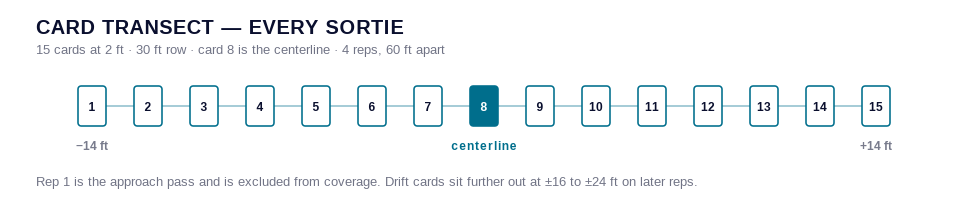
Diagram of fifteen spray cards on a 30 foot row, with card 8 marked as the centerline.
Study layout used on every farm row. Cards sit every 2 ft from −14 to +14 ft. Drift cards on later reps extend to ±24 ft.
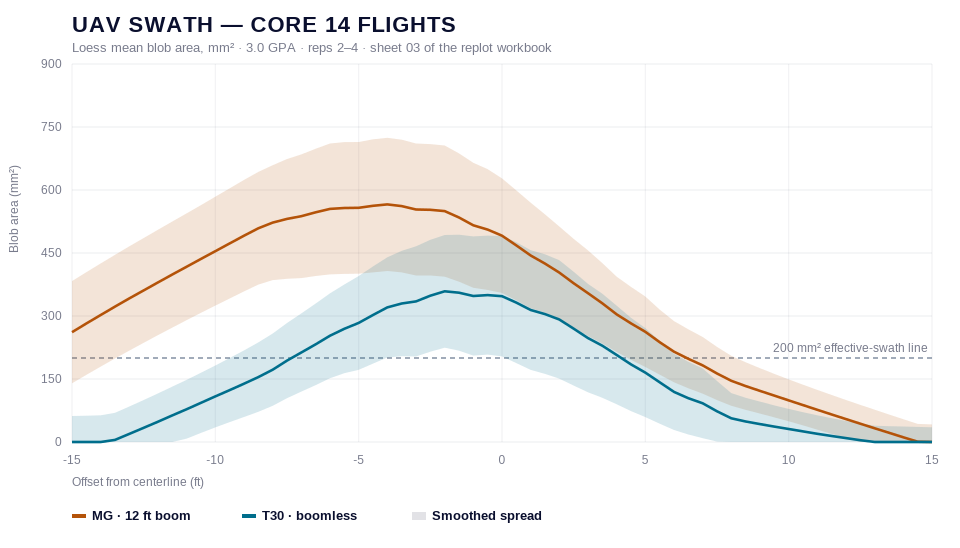
Line chart of blob area versus offset. The T30 curve is narrow and peaks near the centerline. The MG curve stays wider past 8 feet. A dashed line marks 200 square millimetres.
Core 14 flights, the same filter as the original study charts. Effective swath, where blob area stays at or above 200 mm², is about 8.0 ft on the T30 and 18.5 ft on the MG. Card-area CV is 101% for the T30 and 65% for the MG. Bands are the smoothed spread from the workbook, not a confidence interval.
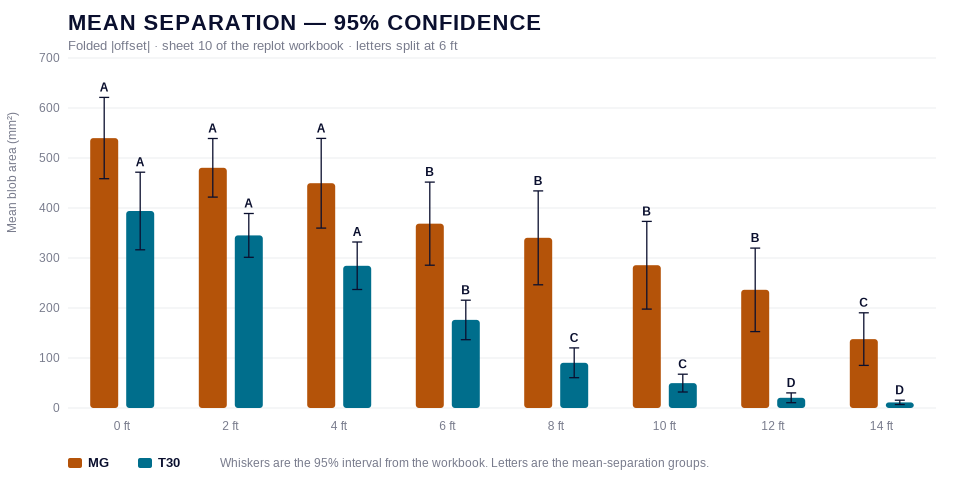
Grouped bar chart of mean blob area for MG and T30 at offsets from 0 to 14 feet, with 95 percent confidence whiskers. The two airframes separate at 6 feet.
Mean deposit by distance from the centerline. The MG and T30 intervals still overlap inside 4 ft. At 6 ft the groups split, which is the 12 ft swath call in the source study.
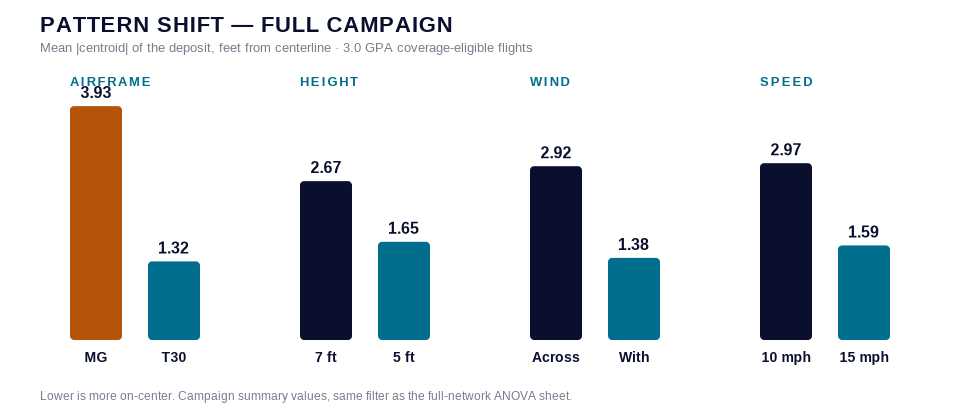
Bar chart of how far the deposit sits from centerline. T30, 5 feet above canopy, with-wind, and 15 miles per hour are the more centered settings.
Full-campaign |centroid|. Across-wind moves the pattern to 2.92 ft, with-wind to 1.38 ft. Seven feet above canopy sits at 2.67 ft, five feet at 1.65 ft. Fifteen miles per hour is more centered than ten.
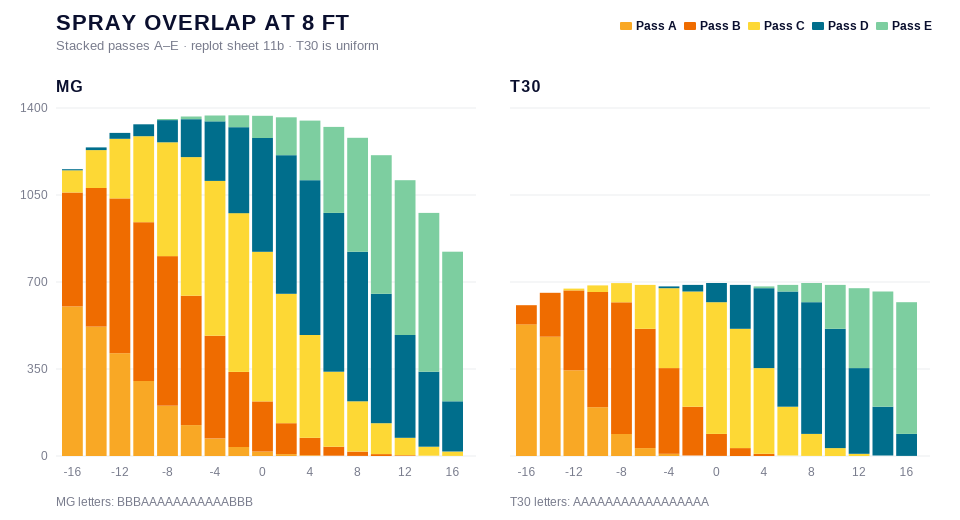
Two stacked column charts of overlapping spray passes at an 8 foot lane. The T30 columns are even and all letter A. The MG columns still mix A and B at the edges.
Lane overlap from 16 ft down to 8 ft was simulated by stacking the single-pass profile. At 8 ft the T30 row is letter A all the way across. The MG row is still A in the middle and B at the edges. That is the operational lock: proceed with an equivalence check at an 8 ft T30 swath, 5 ft above canopy, 15 mph.
UAV
T30 is peaked
Boomless deposit is narrower. Full-campaign |centroid| is 1.32 ft on the T30 and 3.93 ft on the MG. The MG’s 12 ft boom lays a wider pattern, shifted slightly left of centerline.
Not a driver
Droplet class
Very coarse and extra coarse were sparse, so they were pooled. Droplet class does not move the centroid in this GPA band. Full-campaign p is about 0.28, in line with the source study’s 0.26.
Ops
Tank and height
The MG 10 L tank often empties on the crop strip at 3.0 GPA. The T30 30 L tank does not. Height is above the canopy, so banana, citrus, and sugarcane fly higher above the ground than rice or chili.

Figures are redrawn from T30_Swath_Evaluation_Replots.xlsx (loess swath, mean separation, 8 ft overlap) and the campaign summary that feeds that workbook. The logs are engineering reconstructions on the iPollen8 site list. They use the 2022 study’s layout and findings. They are not recovered raw telemetry from that study, and they are not a regulatory filing or a product-efficacy claim.

Stop, monitor,
sell

Stop
Crop disease · iPollen8
Aerial application of crop enhancers and protectants, aimed at disease pressure on open fields.
Monitor
Plants and soil
Scheduled agronomy checks of the farm field: crops and soil, on a repeatable visit.
Sell
Bounty harvest
Early assessment of harvest tonnage, then negotiation with buyers so payment can be locked with offtakers.

From farm
to fork

We care about how food is grown, and about the communities that grow it. Africa uses less than 40% of its 874 million hectares of arable land, and still spends about US $35 billion a year importing food. — Adesina Akinwumi, African Development Bank.

Impact
Invest in impact farmers
Farmers working on community mechanization, agro-inputs, and practice change.
Residue
Zero-residue farmers
Make money while eating healthier. Residue tests are part of the story the original site told for this group.
Practice
Innovative farms
Field practice that includes soil aggregation and the older conditioning methods still used on working farms.

Talk to DroneConduct

Sprayers, checkers, farmers, and offtakers. Write Aerial Labs and the note is routed to the DroneConduct team.

arinze@avius.ai